
Published June 14, 2026 · 5 min read
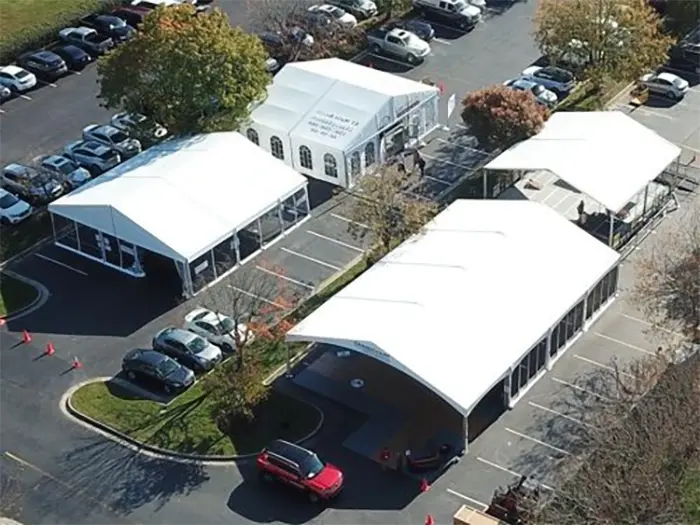
Not every event happens on a grassy field. Corporate functions, festivals, and grand openings often take place on parking lots, plazas, courtyards, and driveways. So the question comes up a lot: can a tent be installed on pavement? The answer is yes — tents are installed on asphalt, concrete, pavers, and brick all the time. The difference comes down to how the tent is anchored.
Staking vs. weighting: how tents anchor on hard surfaces
On grass and soft ground, a tent is secured with stakes driven deep into the earth. On a hard surface you obviously can't stake, so the tent is anchored with ballast weights instead — water barrels, concrete blocks, or engineered steel weights attached to every leg and anchor point. The amount of weight isn't guesswork: it's calculated to the tent's size and the wind loads it needs to withstand, the same safety standard used for a staked install. Done correctly, a properly ballasted tent on pavement is just as secure as one staked into a lawn.
How tent ballasting works on concrete and asphalt
Ballasting means anchoring each tent leg and tie-down point with heavy weights that resist wind uplift in place of stakes. On a concrete or asphalt site, the most common ballast types are:
- Concrete block weights: purpose-made cast blocks set at each leg — the workhorse for hard-surface installs, ranging from tens to several hundred pounds each.
- Water barrels and ballast tanks: drums filled on-site, a flexible option that adds no transport weight until they're on location.
- Steel or cast-iron plate weights: compact, high-density weights for tight layouts where space around the perimeter is limited.
The total ballast isn't a fixed number — it's engineered to the tent's size, height, and sail area and to the wind loads called for by the manufacturer's specifications and local code. A large structure tent can require thousands of pounds of ballast distributed across its anchor points. The weights are connected to the frame with rated straps or ratchets, placed evenly at every leg and corner, and set on protective pads so they don't mark the surface. Because anchoring is what keeps a tent standing safely in a gust, ballasting should always be sized and installed by an experienced crew — never improvised with whatever is on hand.
What surfaces can a tent go on?
Just about any firm, stable surface: asphalt parking lots, poured concrete, paver and brick patios, courtyards, plazas, and driveways. Tents can also go over mixed surfaces — part grass, part pavement — by combining staking and weighting. If the surface is uneven or slopes for drainage, we can add sub-flooring or event flooring to create a level, comfortable base.
Key considerations for a pavement install
- Anchor weight and footprint. Ballast takes up space around the perimeter — plan for it when laying out the site.
- Surface protection. Weights sit on protective pads, so there's typically no drilling and no damage. If drilled anchors are needed, the small holes are patched.
- Drainage and leveling. Pavement often slopes; sub-flooring or sidewalls can keep guests dry and the floor level.
- Permits. Larger tents — especially in parking lots — may require a permit or fire-marshal approval. We can help you understand what your site and city require.
Which tent is best for pavement?
Frame tents and engineered structure tents are the best fit for hard surfaces — they're freestanding with no center poles and are simple to ballast. Clear-top frame tents are a popular upgrade for upscale events on plazas and courtyards. Pole tents, by contrast, rely on staking and tensioning, so they're better suited to open grass.
Planning a tent on a paved site?
Knights Tent & Party Rental installs tents on pavement, concrete, and asphalt across Southeast Michigan — for corporate events, festivals, grand openings, and more — with engineered anchoring, attentive five-star service, and competitive pricing that delivers exceptional value. Send us your site details and we'll recommend the right tent and anchoring plan. Request a free quote or call (248) 238-2400.